By Jenny Holly Hansen | Surrey City News | May 4, 2026

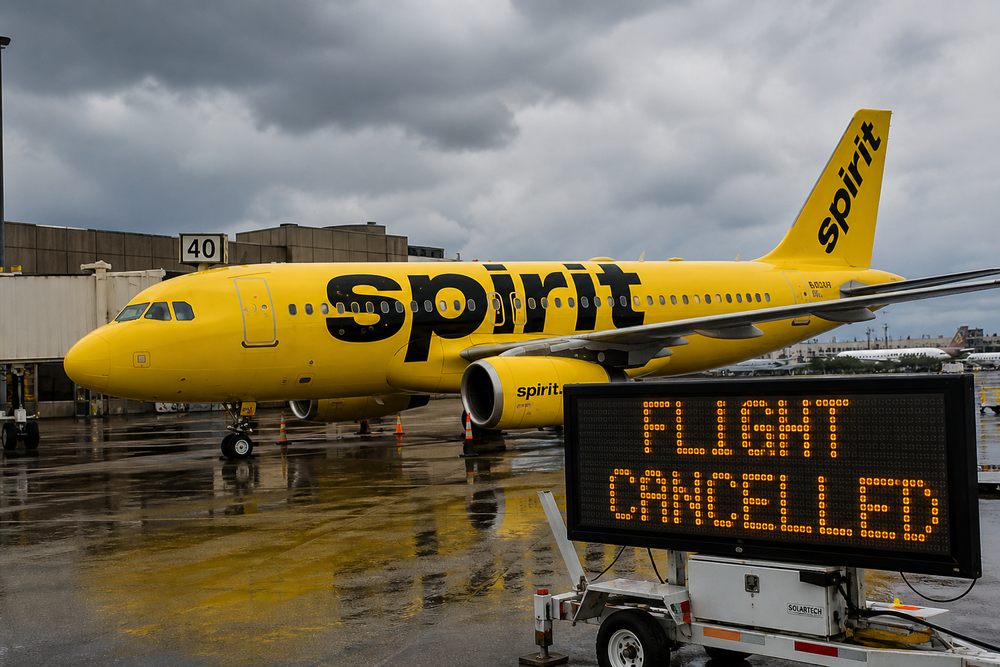
For decades, Spirit Airlines stood out as one of the most recognizable ultra-low-cost carriers in North America. Its bright yellow planes and rock-bottom fares made it a familiar option for budget-conscious travelers—including many Canadians willing to cross the border in search of cheaper flights.

But in 2026, Spirit’s long-running struggles came to a head. What followed wasn’t the result of a single failure, but rather a convergence of pressures—strategic missteps, financial strain, and finally, a global shock that exposed just how fragile its model had become.

A Quiet but Real Role in Canadian Travel

While Spirit Airlines didn’t operate extensively within Canada, it played a meaningful role in how many Canadians traveled.

Border airports like Bellingham, Buffalo, and Detroit became gateways for Canadians looking to bypass higher domestic airfare. For many, the equation made sense: a short drive across the border could unlock significantly cheaper flights to popular destinations across the U.S.

There’s no precise public figure for how many Canadians flew Spirit annually. However, given the airline’s scale—serving tens of millions of passengers each year—and its popularity in border regions, it’s reasonable to conclude that hundreds of thousands of Canadians used Spirit flights annually as part of cross-border travel strategies.

A Model Under Pressure

Spirit’s ultra-low-cost model—charging a bare minimum upfront and adding fees for everything else—was once disruptive. But over time, larger airlines adapted. “Basic economy” fares allowed competitors to match Spirit’s pricing while offering a more traditional flying experience.

Strategic Setbacks

A proposed merger with JetBlue, which could have reshaped Spirit’s future, was ultimately blocked by regulators. That left the airline without a clear path forward at a critical moment.

At the same time, Spirit began shifting toward more competitive, mainstream routes—placing it in direct competition with larger, better-capitalized airlines. The move diluted its niche and increased operational pressure.

Financial Fragility

Even before global events intervened, Spirit had not fully recovered from years of financial challenges. Profitability remained elusive, and the company had already begun scaling back operations—cutting routes, reducing capacity, and searching for stability.

SPONSORED

If your business is navigating similar uncertainties, now may be a good time to explore your insurance options and ensure you’re fully covered.

Learn more

The External Shock: Energy Markets in Turmoil

In 2026, escalating conflict involving Iran began to significantly disrupt global energy markets. Tensions in and around the Strait of Hormuz, one of the world’s most critical oil transit routes, created instability in shipping lanes. While not completely shut down, the region became increasingly difficult and risky for vessels to navigate. The result was predictable: oil prices surged, and jet fuel costs climbed sharply.

For airlines, fuel is one of the largest operating expenses. For a carrier like Spirit—built on thin margins and ultra-low fares—the impact was especially acute. Unlike larger competitors, Spirit had limited flexibility. It couldn’t easily raise prices without undermining its core value proposition. And it didn’t have the same financial cushion to absorb sustained cost increases.

The Tipping Point

What had once been manageable challenges—tight margins, competitive pressure, strategic uncertainty—became far more difficult to sustain in a higher-cost environment. In that sense, the energy shock didn’t create Spirit’s problems but it accelerate them.

What Comes Next

Low-cost models can be incredibly effective—but they are also highly sensitive to external shocks. When fuel prices rise quickly or unpredictably, the margin for error disappears. For Canadian travelers, the ripple effects may be subtle but meaningful:

  • Fewer ultra-low-cost options from nearby U.S. airports
  • Less incentive for cross-border airfare strategies
  • Potential upward pressure on ticket prices overall

A Measured Conclusion

Spirit Airlines wasn’t undone by a single event, nor by a single decision. It was a company already navigating structural challenges. One that found itself exposed when global conditions shifted rapidly. The disruption in energy markets didn’t close the airline on its own, but it contributed to a set of conditions that became increasingly difficult to overcome.

In the end, Spirit’s story is less about one moment of failure and more about how quickly pressure can compound in industries where margins are thin and resilience is hard-won.

Let’s Keep Talking:

Jenny Holly Hansen, Business Insurance Broker since 2006.

Phone: 604-317-6755   Email: hello@jennyhollyhansen.ca

LinkedIn https://www.linkedin.com/in/jenny-holly-hansen-365b691b/.  

TAGS:  #Jenny Holly Hansen #Protect Your Business #Community Impact #Langley Connect #Surrey Connect #Connect Network #Spirit Airlines

Share this article
The link has been copied!