By Jenny Holly Hansen | Langley News | August 1, 2026
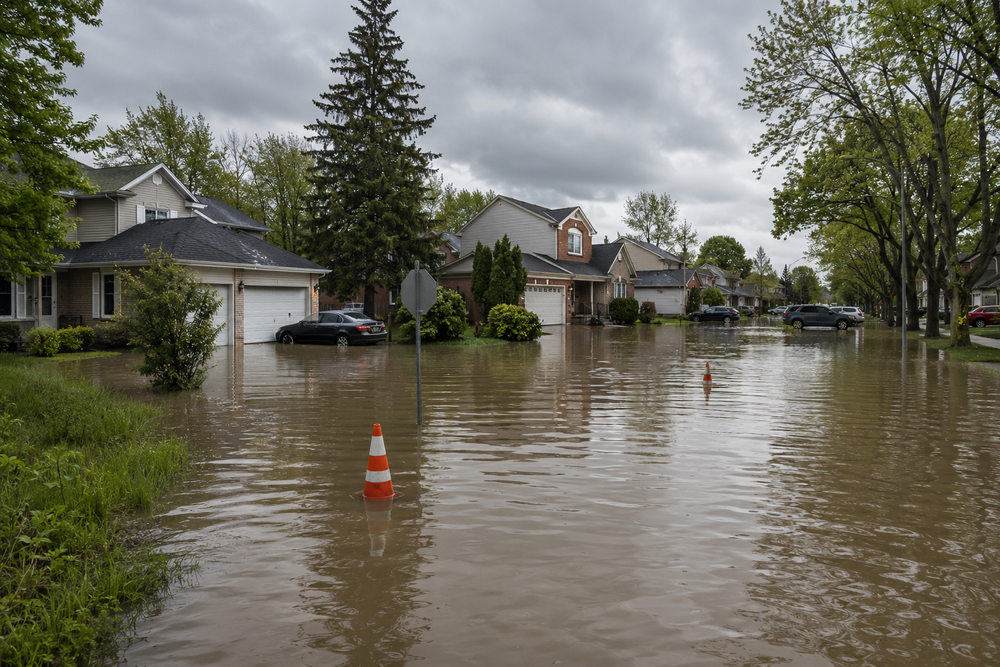
Flooding has become Canada’s most costly natural disaster, affecting homes, businesses and communities in every province and territory. A new report from Insurance Bureau of Canada (IBC), The State of the Flood Insurance Market in Canada, examines how dramatically the country’s flood insurance market has evolved, and why insurance alone cannot solve Canada’s growing flood problem.
The progress is significant. Approximately 94% of Canadian residential properties are now eligible for overland flood insurance, a product that was largely unavailable before 2015. The percentage of homeowners purchasing the coverage has also risen sharply, from approximately 26% in 2017 to more than 70% in 2023.
However, greater access to insurance does not mean the risk has disappeared. Flood losses are increasing, some properties remain extremely difficult to insure, and many Canadians still underestimate their exposure.
Flooding Is No Longer an Occasional or Localized Problem
Flood risk exists across Canada and can take several forms, including overflowing rivers and lakes, coastal flooding, rapid snowmelt, extreme rainfall, surface-water accumulation and sewer backup.
Insured catastrophe losses in Canada have risen dramatically. During the early 2000s, annual losses were generally below $1 billion and often did not exceed $500 million. Over the past decade, they have averaged approximately $3.7 billion annually, while 2024 established a record of $9.4 billion.
According to IBC, Flood and water events accounted for 55% of insured catastrophe losses in 2025 and 34% of losses over the preceding five-year period. Over the last decade, insured catastrophe losses connected to flooding and water totaled $11.2 billion—and 60% of that amount occurred during the most recent three years.
These figures represent insured losses only. Uninsured property damage, interruptions to business operations, public infrastructure repairs and government disaster assistance add substantially to the total economic cost.
What Has Changed in the Insurance Market?
Before 2013, Canadian homeowners could generally purchase sewer backup coverage, but insurance for water entering a home from overland flooding was largely unavailable.
The major floods in southern Alberta and the Greater Toronto Area in 2013 became a turning point. The events exposed a serious gap in Canada’s approach to flood recovery and encouraged insurers to invest in better ways of understanding and pricing the risk.
Since then, improved flood mapping, catastrophe modelling, geospatial analytics and property-level assessment tools have made it possible to evaluate individual properties more accurately. Instead of classifying an entire neighbourhood or region as high risk, insurers can make more precise decisions based on the characteristics and location of a particular property.
Risk-based pricing and increased competition have also helped expand the market. In 2023, approximately 88% of policyholders with overland flood coverage paid $300 or less annually for it, according to the report.
Reducing risk starts with understanding your coverage—reach out for an independent review of your home insurance coverage.
Eligibility Does Not Mean You Automatically Have Coverage
One of the most important messages for homeowners is that being eligible for flood insurance is not the same as having it.
Overland flood protection is commonly offered as optional coverage or as part of a water-damage package. Sewer backup and overland flooding are also different risks and may be addressed by separate coverages, limits, deductibles and exclusions. Homeowners should ask their insurance advisor:
- Does my policy include both overland flood and sewer backup coverage?
- Are coastal flooding, groundwater or seepage excluded?
- What limits and deductibles apply?
- Would the policy cover the full cost of repairing my home and replacing its contents?
- Does it include additional living expenses if I must leave my home?
- Are detached structures, finished basements and landscaping covered?
- What flood-prevention measures could improve my protection or reduce my premium?
Policy wording varies by insurer, so assumptions can become very expensive after a loss.
The Remaining Protection Gap Is Highly Concentrated
Although approximately 94% of residential properties are eligible for coverage, an estimated 850,000 homes—or roughly 6%—remain ineligible.
More importantly, approximately 2% of residential properties account for an estimated 57% of potential flood losses. These properties may be located in flood plains, river valleys, coastal areas or locations that experience chronic surface-water flooding. Some have already flooded repeatedly.
This concentration creates a difficult insurance problem. Insurance works best when losses are uncertain and distributed across a large group. If a property is expected to flood frequently, the anticipated cost of claims may be too high to support an affordable premium.
For people buying a home, the findings reinforce the importance of investigating flood risk before removing conditions on a purchase. Previous flooding, insurability, available limits and the cost of coverage can affect not only household finances but also a property’s future value and marketability.
What Business Owners Should Consider
While IBC’s availability and uptake figures relate primarily to residential insurance, the broader findings are equally relevant to businesses. A flood can damage far more than the building itself. It may destroy equipment, inventory, records and technology while preventing employees and customers from accessing the premises. Business owners should review:
- Whether the building and business contents are insured against overland flooding and sewer backup
- Whether tenants are responsible for insuring improvements they have made to leased premises
- Business-interruption coverage and the length of the indemnity period
- Extra-expense coverage for temporary premises, equipment rentals or emergency operations
- Coverage for property stored in basements or below ground level
- Supply-chain and dependent-business-interruption exposures
- Flood risks affecting utilities, roads, suppliers and neighbouring properties
- Emergency response, data backup and business-continuity plans
Even a business located outside a recognized flood plain can suffer from extreme rainfall, inadequate drainage or inaccessible roads. Business owners should consider both direct property damage and the income they could lose while recovering.
Canadians May Still Be Underestimating the Risk
Despite rising insurance uptake, a significant awareness gap remains. The report refers to survey findings indicating that 62% of Canadians were not concerned about flooding in their home or community. Another survey found that 53% did not plan to take steps to protect their homes.
That lack of concern can be costly. Flood maps and historical experience are useful, but past conditions do not necessarily reflect future risk. New development, aging drainage systems, increased pavement and changing weather patterns can all alter how water moves through a community.
Practical Steps Can Reduce Damage
IBC argues that Canada’s next priority must be reducing the risk itself. Insurance provides financial assistance after a loss, but it cannot prevent the disruption, displacement and emotional strain that accompany a flood. Property-level improvements may include:
- Installing and maintaining a backwater valve
- Using a sump pump with battery backup and an alarm
- Improving grading so water drains away from the building
- Keeping gutters, downspouts and nearby drains clear
- Directing downspouts away from the foundation
- Waterproofing foundations and sealing vulnerable openings
- Raising valuable equipment, documents and utilities above basement level
- Avoiding the storage of irreplaceable items in flood-prone areas
- Preparing an emergency and business-continuity plan
Before making changes, property owners should consult qualified professionals and confirm local building requirements. They should also ask their insurer whether particular upgrades affect eligibility, coverage or pricing.
Communities and Governments Have a Role
Individual action cannot solve a community-wide problem. The report calls for stronger land-use planning, better development controls in high-risk areas, investments in stormwater systems and flood defenses, property-retrofit programs, and modern, publicly accessible flood maps.
The economic argument is compelling: research cited in the report indicates that every dollar invested in climate adaptation can generate as much as $15 in direct and indirect benefits through avoided losses, reduced disruption and stronger economic resilience.
For properties exposed to severe and repeated flooding, retrofits may not be enough. IBC recommends considering voluntary buyout and relocation programs that help people move away from locations where rebuilding repeatedly is neither financially nor practically sustainable.
The report also supports a narrowly targeted national flood insurance program for households facing the greatest barriers to obtaining affordable coverage. Such a program would complement the private market rather than replace it and should preserve incentives to reduce risk.
The Bottom Line
Canada has made remarkable progress in expanding access to overland flood insurance. The challenge has shifted from widespread unavailability to a more focused—and difficult—problem involving properties with severe or recurring exposure.
For most homeowners, the immediate priority is to confirm what their policy actually covers. For business owners, it is essential to consider property damage and the interruption that could follow. For buyers, developers and communities, flood risk should be investigated before—not after—major financial and land-use decisions are made.
Insurance remains an essential part of recovery, but Canada’s long-term resilience will depend on something more fundamental: preventing avoidable losses and making smarter decisions about where and how we build.
Source: Insurance Bureau of Canada,InBrief_2026 Flood Ins Market (002).pdf, July 2026. Insurance coverage varies by provider and policy wording; property owners should speak with a licensed insurance professional about their individual risks and coverage.
This article is provided for general information only and does not constitute legal advice or a description of coverage under any particular policy. Coverage differs by insurer and is subject to the applicable policy wording, limits, deductibles, conditions and exclusions.
TAGS: #Jenny Holly Hansen #Protect Your Home #Protect Your Business #Community Impact #Business Unlimited Network (BUN) #Langley Connect #Surrey Connect #North Van Connect #Connect Network #Overland Flood Coverage #Sewer Back-Up Coverage
Let’s Keep Talking: Jenny Holly Hansen, Insurance Broker since 2006. Phone: 604-317-6755 Email: hello@jennyhollyhansen.ca Website: jennyhollyhansen.ca LinkedIn https://www.linkedin.com/in/jenny-holly-hansen-365b691b/.